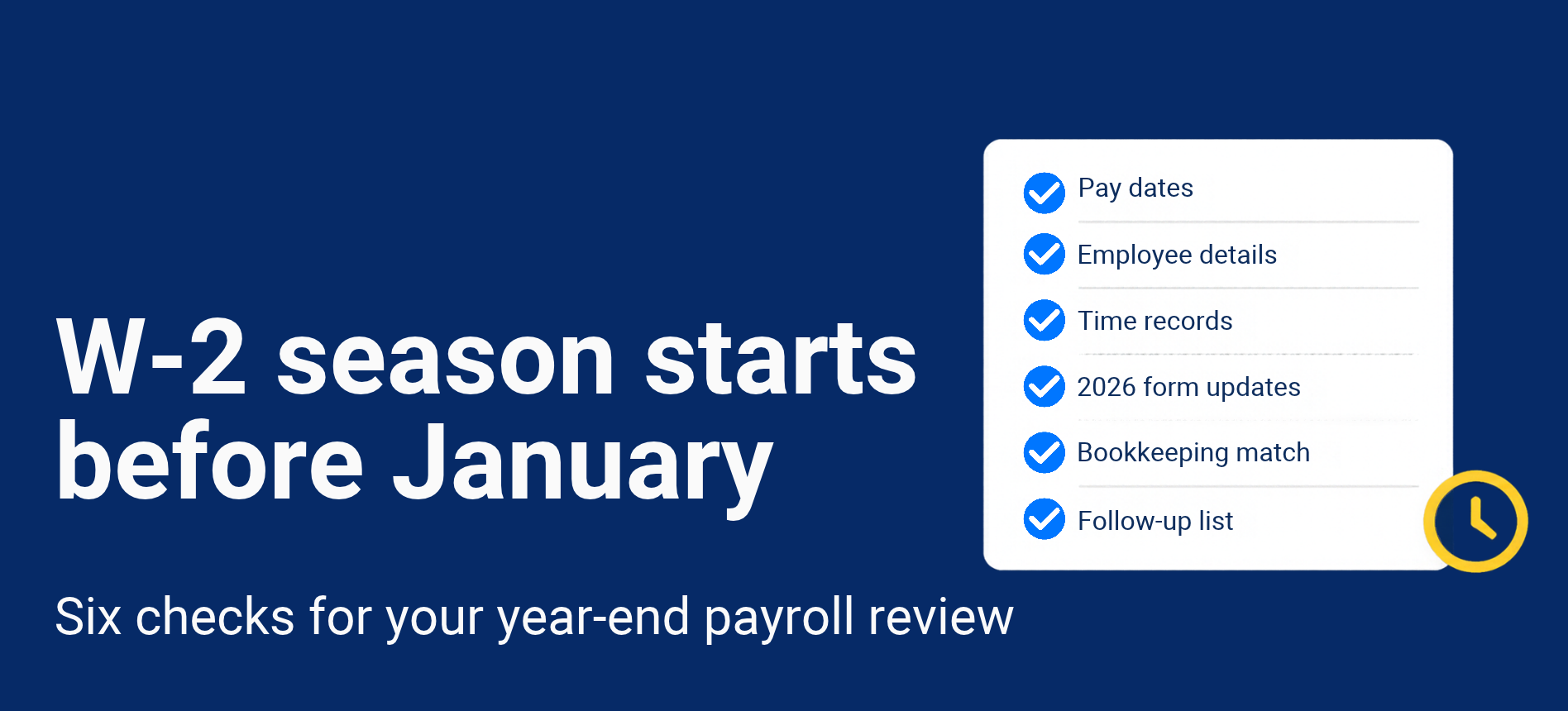

Quick answer: W-2 season goes more smoothly when you review payroll records before the year closes. Check the date each paycheck is paid, confirm employee details, gather time and pay records, and ask your payroll or tax professional about the 2026 form updates. The IRS says 2026 Forms W-2 are due to employees and the Social Security Administration by Feb 1, 2027.
What should crew owners know about 2026 W-2 timing?
The IRS says 2026 Forms W-2 must be furnished to employees and filed with the Social Security Administration by Feb 1, 2027. The IRS also explains that W-2 reporting is based on wages paid during the calendar year. In other words, the date a crew member worked and the date the paycheck is paid can put a payment in different tax years.
Tax guidance can change, so recheck the current IRS instructions before you rely on any date. This guide is general information as of 2026.
Six checks to make before year-end
1. Confirm the pay-date cutoff
Look at the scheduled pay dates around the end of December. The IRS says wages go on the W-2 for the calendar year in which they are paid. Its example notes that wages for work completed in December but paid on Jan 1 belong on the following year's W-2. Ask your payroll professional how your final 2026 and first 2027 pay runs should be recorded.
2. Review employee details
Check names and mailing details against your current records, and confirm that any corrections use your approved, secure process. If an employee's information does not match what is in payroll, ask your provider or tax professional how to resolve it. Avoid sending sensitive employee details through an unapproved channel.
3. Gather time and pay records
Make sure the hours, time edits and payroll adjustments for the final pay periods have been reviewed. Collect records for tips, overtime, off-cycle payments and other items that may need attention. Do not guess how an item should be classified or reported. Ask a qualified payroll or tax professional.
4. Check the 2026 W-2 instructions for new reporting details
The IRS's 2026 instructions describe updated reporting for certain items, including qualified tips and overtime compensation, and employer contributions to Trump accounts where applicable. They add specific W-2 box and code details for these items. Do not assume that a prior-year process still covers every situation. Ask your payroll provider or tax professional which instructions apply to your business and employees.
5. Compare payroll summaries with your bookkeeping
Review year-to-date payroll summaries alongside your bookkeeping records. If totals do not line up, write down the difference and ask your payroll provider or accountant to look into it before forms are prepared. A short question now is easier to resolve than a surprise during filing.
6. Make a short follow-up list
Keep one list of open questions, missing approvals and corrections. Give each item an owner and a next step, then check that the answer made it into the final payroll records. Keep the list focused on items your payroll or tax professional can confirm.
A little preparation beats a January scramble
Before Feb 1, 2027, review pay dates, employee details, time and pay records, and any 2026 reporting changes with a qualified professional. Requirements can depend on the details of your business and the payments involved.
Frequently asked questions
When are 2026 Forms W-2 due?
The IRS's 2026 General Instructions say Forms W-2 must be furnished to employees and filed with the Social Security Administration by Feb 1, 2027. Recheck the current IRS instructions before relying on a deadline.
Does work completed in December always appear on the 2026 W-2?
Not necessarily. The IRS says W-2 reporting is based on wages paid during the calendar year. Ask your payroll professional how a payment dated in January should be handled.
Did the 2026 W-2 instructions change?
Yes. The IRS's 2026 instructions include updated reporting details for certain items, including qualified tips and overtime compensation. Which details apply depends on the facts, so confirm with a payroll or tax professional.
Is this checklist tax advice?
No. It is a planning aid. Use the IRS instructions and a qualified professional for questions about how the rules apply to your business.
Get year-end payroll off your plate
Your crew keeps you busy enough. See how Hourly connects time tracking, payroll and workers' comp in one app: Try Hourly or book a demo. Then talk with your payroll or tax professional about your year-end process.
Disclaimer: This blog post is provided for general educational and informational purposes only and does not constitute tax, legal, accounting, insurance or financial advice. Payroll, employment tax and Workers' Compensation requirements vary by state, industry and individual circumstances, and laws and regulations change. Before making decisions about payroll providers, tax filings, insurance coverage or compliance, consult a qualified tax professional, accountant, attorney, insurance advisor or other financial professional who can advise on your specific situation. References to third-party sources and websites are provided for convenience and do not imply endorsement, and Hourly is not responsible for their content.


